Printable coloring page
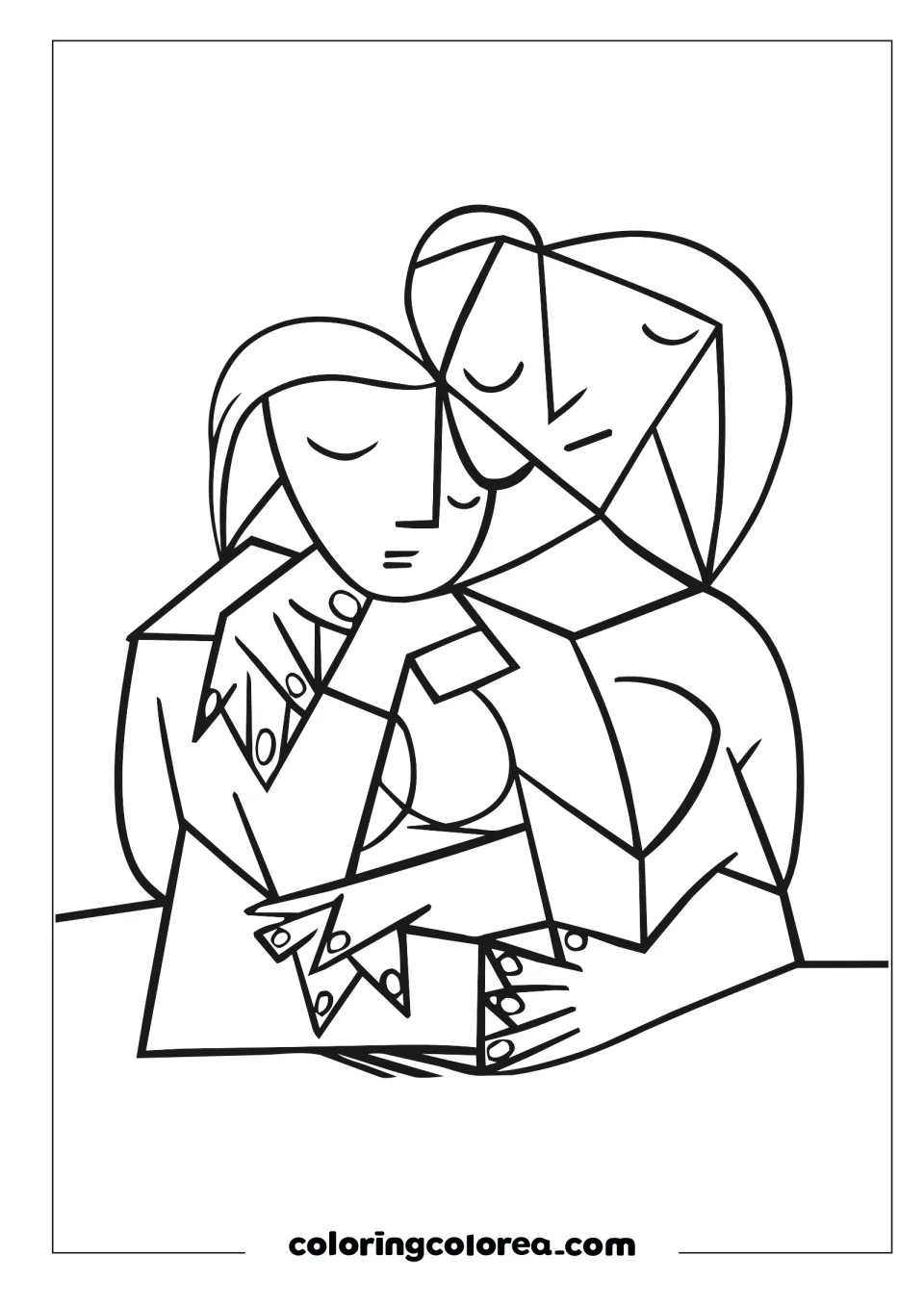
Picasso women reading: two figures hugging, with geometric faces and lowered eyes. An art printable for kids and families; download the free PDF.
Printable coloring page
Free for personal and educational use
Download coloring page (PDF)PrintColor it in your browser, no sign-up needed. Your progress is saved on this device.
Two women hugging with half-closed eyes, faces built from geometric planes, interlocked hands and the edge of a table.
Fill each shape with flat, bold colors and keep the black outlines strong.
Draw a family member's face with one eye seen from the front and the nose in profile.
Picasso signed his work with his mother's last name instead of his father's, which was Ruiz.
Picasso women reading scenes open a window into the world of one of the most influential artists of the twentieth century. Pablo Picasso was born in Málaga, Spain, in 1881, and he could draw remarkably well as a young boy. His father, an art teacher, gave him his first lessons.
Picasso changed styles many times. Together with French painter Georges Braque, he invented cubism, a way of painting that breaks objects and faces into geometric shapes and shows them from several angles at once. That is why a face in a Picasso painting can look straight at you and turn sideways at the same time.
During the 1930s, he painted a number of calm scenes of women reading, sleeping or daydreaming. He used soft curves, thick black outlines and bright colors that almost look like stained glass. The figures tilt their heads, lean on each other and seem lost in their own thoughts.
Picasso kept working until he died in 1973, leaving behind thousands of paintings, drawings, sculptures and ceramics. His art hangs in major museums around the world, including the Museum of Modern Art in New York. His biggest lesson for young artists is simple: you do not have to copy reality exactly to show how you feel.