
Printable coloring page
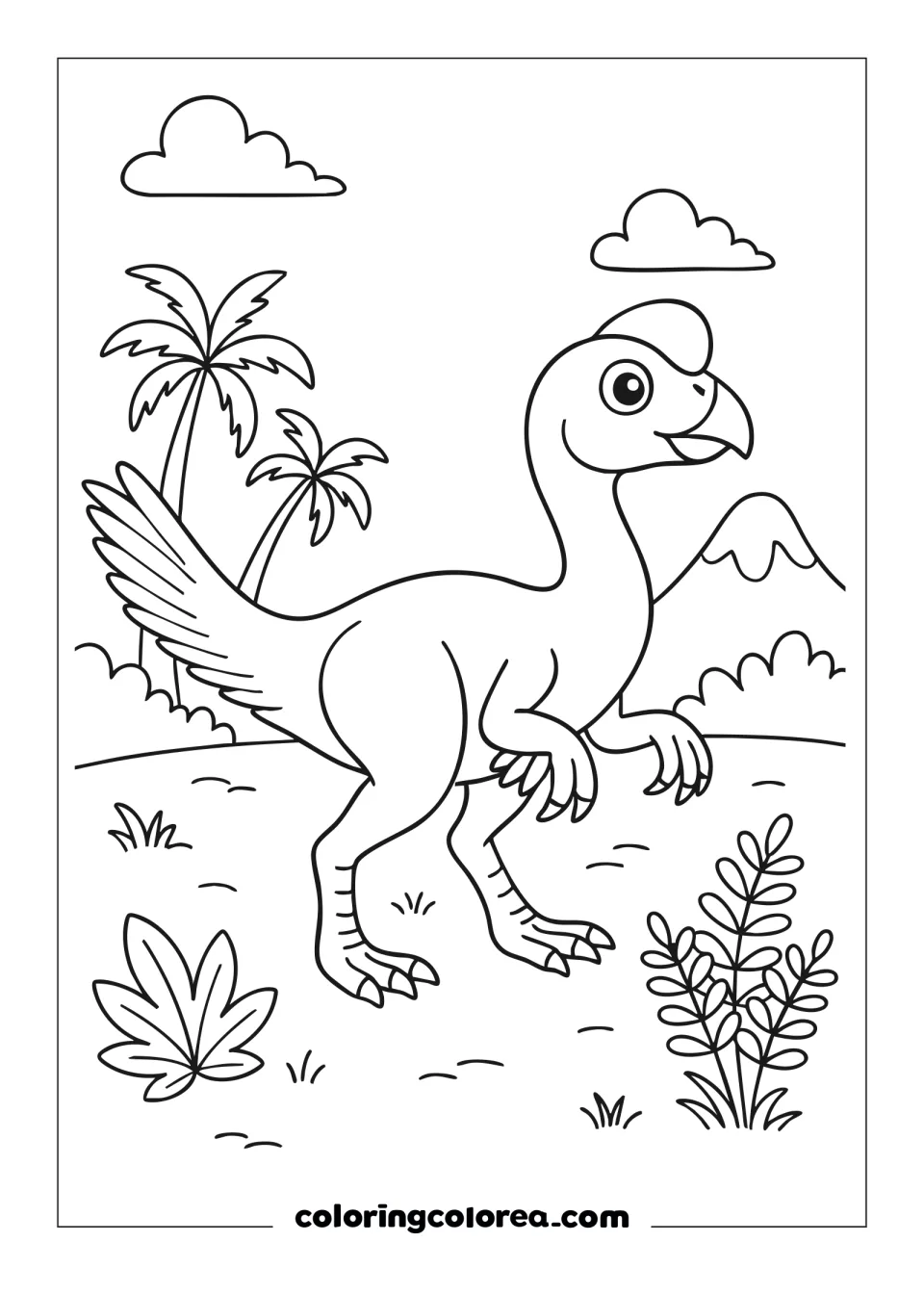
This feathered ornithomimus struts past palm trees and a mountain with its fan tail. Get the free PDF of this beaked dinosaur page and add bright colors.
Printable coloring page
Free for personal and educational use
Download coloring page (PDF)PrintColor it in your browser, no sign-up needed. Your progress is saved on this device.
Long-necked dinosaur with a beak, a rounded crest and a feathered tail, palm trees, a mountain and leafy plants.
Blend several colors on the tail like the feathers of a tropical bird.
Find a photo of an ostrich and point out what it shares with this dinosaur.
The name ornithomimus means bird mimic.
One look at a feathered ornithomimus and you can see why its name means bird mimic. This dinosaur lived about 70 million years ago in western North America, including present-day Alberta and Colorado, and it looked remarkably like an ostrich with arms and a long tail.
Its body was made for speed. Long, slender legs and stretched-out lower leg bones are the same features you see in fast animals today. Some estimates suggest dinosaurs in this family could keep up with a car on a neighborhood street. Running was the best defense it had against huge meat eaters like tyrannosaurs.
Instead of teeth, it had a light beak, and that has kept scientists arguing about what it ate. Odds are it was an omnivore, picking through plants, seeds, insects and small animals. Its long arms ended in slim fingers that may have helped pull branches toward its mouth.
In 2012, researchers in Canada reported ornithomimus fossils that kept traces of feathers, and adults seemed to have wing-like arrangements on their arms. It could not fly, so those feathers may have been for showing off or for shielding eggs. It was the first time plumage had been confirmed in this group in North America, and it made the link between dinosaurs and birds even stronger.
 The Dinosaur Blamed by MistakeDinosaurs · Medium
 Way Smaller Than You ThinkDinosaurs · Easy
 The Plate-Backed Dinosaur Says HiDinosaurs · Easy
 Myths and Facts About a Crested DinosaurDinosaurs · Medium
 A Yummy Leaf for BreakfastDinosaurs · Easy
 The T-Rex Who Was Still GrowingDinosaurs · Easy
 A Sunny Day With a GiantDinosaurs · Easy
 A T-Rex Who Loves to SmileDinosaurs · Easy