
Printable sheet
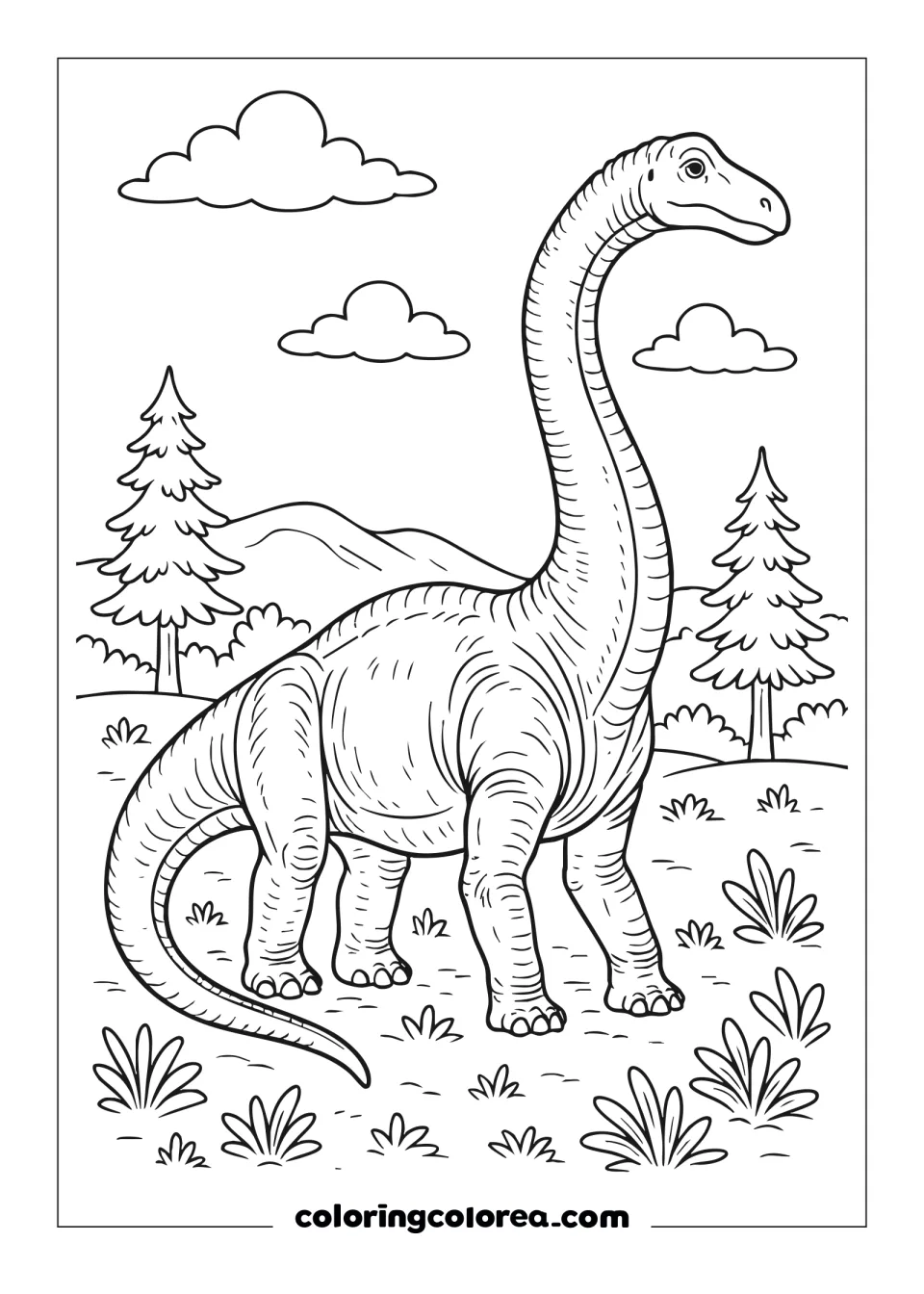
This giant brachiosaurus lifts its neck above pines and hills, with texture all over. Download the free PDF of this detailed, fine-line page.
Printable sheet
Free for personal and educational use
Download PDFPrintRealistic brachiosaurus with finely textured skin, pine trees, rolling hills, shrubs and three clouds.
Follow the direction of the skin lines as you shade to add volume.
Draw a person to scale next to the dinosaur to compare sizes.
The largest known sauropods lived in South America, such as Argentinosaurus.
A giant brachiosaurus raises a great question: how could anything on land get that big? Sauropods, the group it belongs to, were the largest animals ever to walk the Earth. No land mammal has come anywhere close to their size, and the African elephant looks small by comparison.
Part of the answer lies in what they didn't do, which is chew. Because they swallowed plants almost whole, their heads could stay small and light, and that made a very long neck possible. With that reach, they could graze a huge area without moving their bodies, saving a ton of energy.
Breathing helped as well. They had a bird-style system of air sacs that worked better than mammal lungs, and the same system lightened the skeleton by filling bones with air pockets. Without that weight savings, their legs would have had a much harder job.
Reproduction played a part, too. Sauropods laid many eggs, and the young grew fast, so populations could bounce back from heavy losses among hatchlings. An elephant, on the other hand, has one calf after a very long pregnancy. Add in warm Jurassic weather and lots of plants, and you get a combination that nature has never repeated.
 The Fossil Lost in the WarDinosaurs · Hard
 A Rare and Elegant Plant EaterDinosaurs · Medium
 Myths and Facts About a Crested DinosaurDinosaurs · Medium
 A Prehistoric Trumpet by the WaterDinosaurs · Medium
 Two Hunters on the RunDinosaurs · Medium
 A Hunter in the Dense LeavesDinosaurs · Hard
 King of the Tyrant LizardsDinosaurs · Medium
 The Claw Shaped Like a SickleDinosaurs · Medium