
Printable sheet
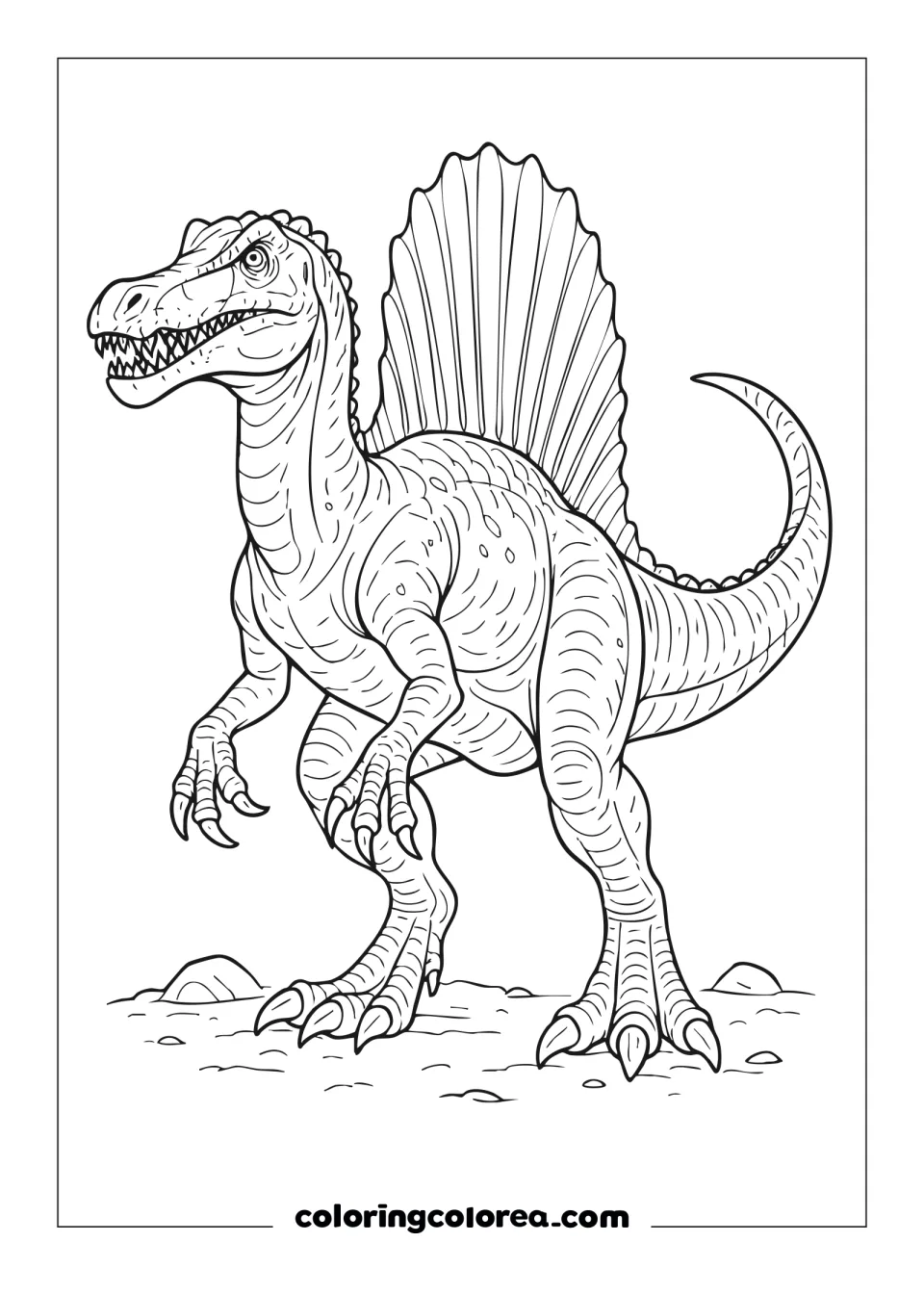
This sail-backed spinosaurus shows off big claws and finely lined skin. Get the free PDF of this realistic, detailed page and take on a real challenge.
Printable sheet
Free for personal and educational use
Download PDFPrintFull-body spinosaurus with a huge back sail, sharp teeth, long claws and finely lined skin.
Fade the sail from orange to red and keep the body in earth tones.
Look up two theories about the sail and pick your favorite.
Some of the spines in its sail stood more than five feet tall.
The sail-backed spinosaurus has a story as dramatic as its looks. Its first bones came out of Egypt, thanks to a team led by the German paleontologist Ernst Stromer, who described the animal in 1915. The fossil, with its gigantic back spines, went to a museum in Munich and sat on display for years.
Then came World War II. In 1944 an Allied bombing raid destroyed the museum and the bones along with it. All that remained were Stromer's notes, sketches and photographs. For decades this dinosaur was little more than a ghost, known to scientists mostly from paper.
Early in this century, new finds in Morocco brought it back to life. A partial skull revealed a very long snout, and later work suggested it was probably the longest land predator known, beating out T-Rex at roughly 46 feet or more. Quite a comeback for an animal that had been erased from the record.
There are still mysteries to solve, and the sail is a big one. Some experts think it regulated body heat, while others say it served as a billboard for attracting mates or looking bigger. Even its posture remains in debate, and reconstructions keep changing. Every new bone from the desert can rewrite what we thought we knew.
 A Rare and Elegant Plant EaterDinosaurs · Medium
 Myths and Facts About a Crested DinosaurDinosaurs · Medium
 Why Sauropods Grew So HugeDinosaurs · Medium
 A Prehistoric Trumpet by the WaterDinosaurs · Medium
 Two Hunters on the RunDinosaurs · Medium
 A Hunter in the Dense LeavesDinosaurs · Hard
 King of the Tyrant LizardsDinosaurs · Medium
 The Claw Shaped Like a SickleDinosaurs · Medium